

Lady @Lady@cat.family

- Header
- Delinquent (BREAKpoint 98a) by Megumi Mizutani
Owner
Administrator / Public Relations for GlitchCat. Not actually glitchy, nor a cat. I wrote the rules for this instance.
“Constitutionally incapable of not going hard” — @aescling
“Fedi Cassandra” – @Satsuma
I HAVE EXPERIENCE IN THINGS. YOU CAN JUST @ ME.
I work for a library but I post about Zelda fanfiction.
Joined Sep 2021
@noelle anyway i think the reason why javascript gets a weird reputation isn’t because it lets you do weird typecasting things but because it lets you do weird typecasting things in very very few characters 😝
@noelle which is why personally i don’t like Python (because i find the “everything is an object” approach to be much simpler to reason about than whatever it is Python does) but i understand how for other people, the incredibly ambiguous mess which is JavaScript would be bothersome lol
@noelle i mean i get it but it is indicative of a fundamentally different understanding of []
in JS, [] is just a special kind of object, and all objects are truthy
Python doesn’t take the same “everything is an object™” approach so you wind up with more exceptional cases like that
@noelle what makes this especially scary is that this is equivalent to "[]True"[2]
like, what??

@noelle that’s definitely weird behaviour, but it falls out of the fact that strings and numbers are the only valid outputs of an addition operation, and having `[] + $` be a number is almost definitely worse
@noelle idk `![]` being false seems expected to me, and `false + false` being 0 makes more sense than it being anything else, so the only part of this which i think might be objectionable is the fact that `[] + $` is a string

DoM PaRsInG AnD SeRiAlIzAtIoN
=============================
DoMpArSeR, xMlSeRiAlIzEr, InNeRhTmL, aNd sImIlAr aPiS
w3c eDiToR’S DrAfT 02 mAy 2021
@djsundog honestly even just like
custom columns based on extended file attributes
i can write a script to set those myself if needbe just let me sort over them please
@alexandra scheme or relatives is a good choice however…
my personal opinion is that while functional programming concepts are good and extremely useful, they are good and useful only for a subset of problems that one might encounter when writing a program…
and more generalist languages have enough support for functional programming these days that they’re generally more pleasant to work with (unless your problems happen to be exclusively those that functional programming is good at).
definitely if your interest is just in transforming data, learn XSLT or Scheme!
otherwise, if you’re already familiar with Javascript, i’d recommend just doing functional stuff in Javascript+Deno… the caveat here is that the JS community is a mess, and it can be hard to get off on the right foot if you don’t already understand the language.
Swift is a very good programming language for functional programming in my experience. it’s probably my favourite language right now in general, although perhaps less because of its strengths and more because of the failings of the rest of them 😝.
NPC dialogue trees be like
• (if the Player is female) Say something sexist
you’re allowed to hate everything if you just get the balances right
i hate work i just hate not-work more
@Rob_T_Firefly one option is “ser”, which is stolen from Dragon Age (/ other fantasy fiction?) but look it’s a really good word
if you don't need a direct analogue for sir/ma’am specifically, “mixter” (from Mx) has been used as an analogue for mister/missus and could fill that role
@djsundog ugh this would be extremely useful to me
i fuckin hate my poetic voice
i wish i knew literally any writers tackling the same sorts of problems i am

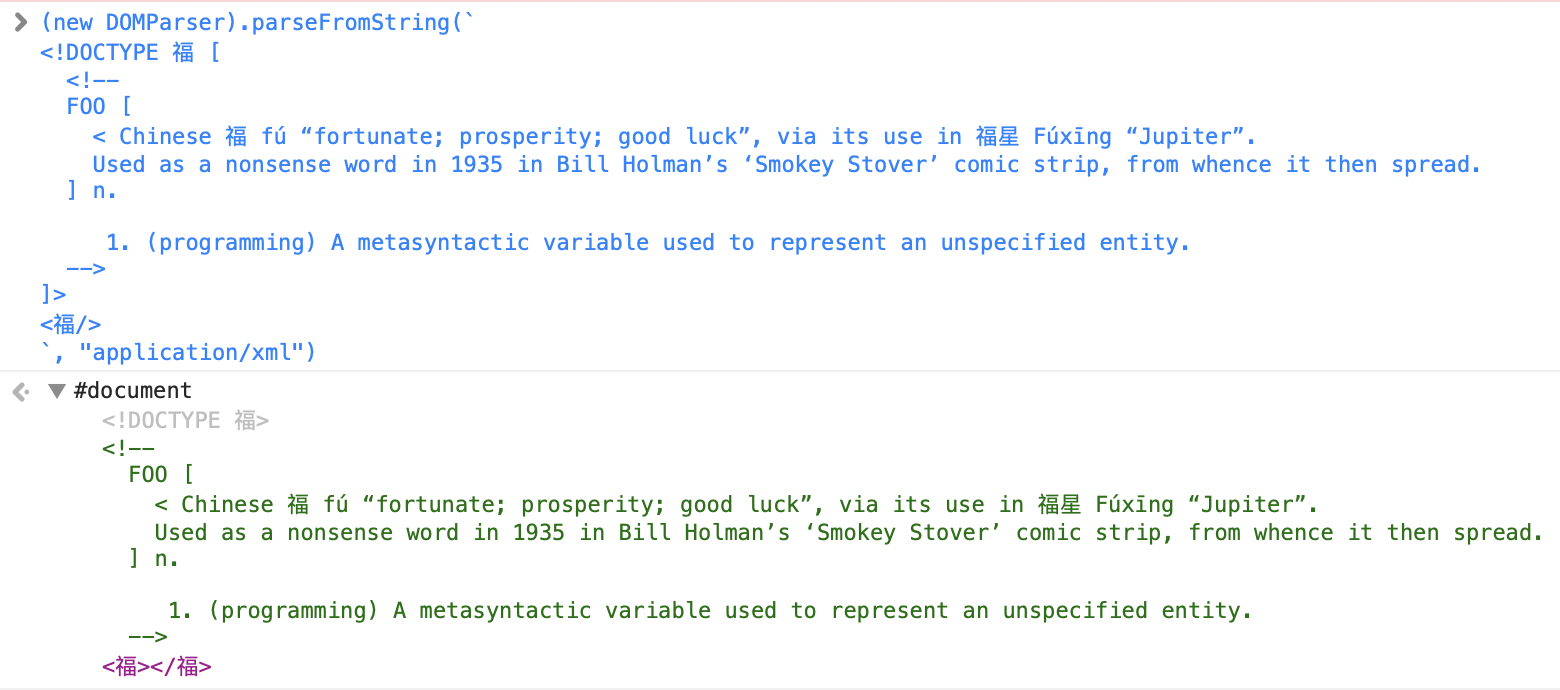
very interestingly, Safari’s X·M·L processor moves comments present in the internal subset of the D·T·D out of the DOCTYPE and places them just before the root element
i would like to say this is non‐standard behaviour, but there actually ⁜is⁜ no standard regarding taking an X·M·L document and parsing it into the D·O·M
- Header
- Delinquent (BREAKpoint 98a) by Megumi Mizutani
Owner
Administrator / Public Relations for GlitchCat. Not actually glitchy, nor a cat. I wrote the rules for this instance.
“Constitutionally incapable of not going hard” — @aescling
“Fedi Cassandra” – @Satsuma
I HAVE EXPERIENCE IN THINGS. YOU CAN JUST @ ME.
I work for a library but I post about Zelda fanfiction.
Joined Sep 2021