
æʃliŋ, loaf of autismo @aescling@cat.family
- website
- https://æscling.cat.family
- neopronouns
- æ / ær / æi / æin / æinselves
- https://misskey-hub.net/ns#isCat
- true
- pawprint
- openpgp4fpr:104798A74A3F3CEA9B29B369B34C7264BB895704
- header
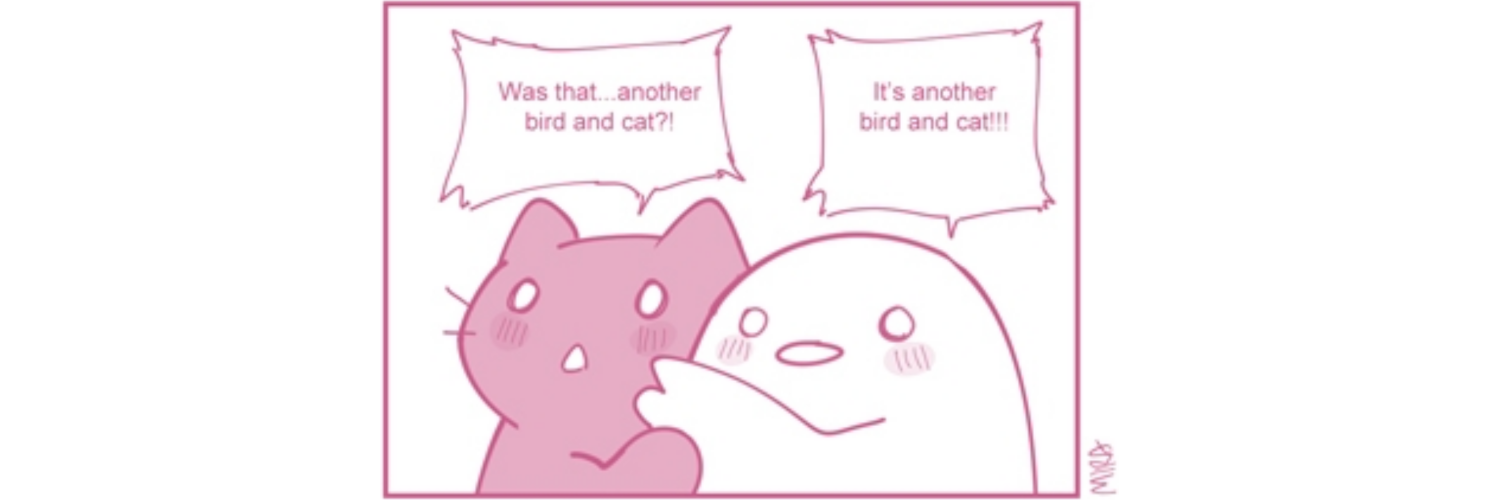
- miss bird and miss cat, by mira ongchua
Owner
it’s pronounced “ashling”. canonically a black housecat or any of the grass cat pokémon, but currently experiencing daily TFs. Commewnist. it/she and more. i automatically change my pfp on the furst post of the day
GlitchCat syscatmin and meowstodev; @ me about techincal problems with the instance, or fur feature requests. i got a job due to some extent to my work on this instance
i have very strong opinions about the sonic furanchise. pokémon has me in a chokehold when it comes to merchandise
available via email with the same username and domain. DM/email for other purrotocols
workplace policy is to clarify that all of my opinions expressed here are my own, and not those of my employer
“all this shit is still incomprehensible but im glad u accomplished something” ―@wallhackio
Joined Sep 2021
context, code re: catflame status
the thing about following the types and using the compiler to find the types of your holes is that, while it will create code that compiles and apparently passes the tests, it will also create code that is inscrutable to YOU
context, code re: catflame status
-- | Filter a list with a predicate that produces an effect.
--
-- >>> filtering (ExactlyOne . even) (4 :. 5 :. 6 :. Nil)
-- ExactlyOne [4,6]
--
-- >>> filtering (\a -> if a > 13 then Empty else Full (a <= 7)) (4 :. 5 :. 6 :. Nil)
-- Full [4,5,6]
--
-- >>> filtering (\a -> if a > 13 then Empty else Full (a <= 7)) (4 :. 5 :. 6 :. 7 :. 8 :. 9 :. Nil)
-- Full [4,5,6,7]
--
-- >>> filtering (\a -> if a > 13 then Empty else Full (a <= 7)) (4 :. 5 :. 6 :. 13 :. 14 :. Nil)
-- Empty
--
-- >>> filtering (>) (4 :. 5 :. 6 :. 7 :. 8 :. 9 :. 10 :. 11 :. 12 :. Nil) 8
-- [9,10,11,12]
--
-- >>> filtering (const $ True :. True :.  Nil) (1 :. 2 :. 3 :. Nil)
-- [[1,2,3],[1,2,3],[1,2,3],[1,2,3],[1,2,3],[1,2,3],[1,2,3],[1,2,3]]
filtering ::
  (Applicative k) =>
  (a -> k Bool) ->
  List a ->
  k (List a)
filtering _ Nil = pure Nil
-- what the fuck even is this
filtering p (k :. ks) = f k <$> p k <*> filtering p ks
  where
    f :: a -> Bool -> List a -> List a
    f _ False as = as
    f a True as = a :. as
catflame status
-- what the fuck even is this
the calculus of inductive constructions would be an acceptable alternative i guess
i guess the closest is the toy language used in The Little Typer
even though the pi calculus is decidedly not hindley-milner
i wish there were a strictly typed LISP using a hindley-milner type system
@The_T @wallhackio @vaporeon_ i don’t like trying to remember that period of time fur myself
æʃliŋ, loaf of autismo
boosted

reposting a cat photo from another social networking purrotocol
æʃliŋ, loaf of autismo
boosted

Via flickr https://flic.kr/p/1112hz1zpS (Tambako The Jaguar)
#Fox #Bot
@coriander he’s purrfect
 ny’all, including you,
æʃliŋ, loaf of autismo
boosted

Via flickr https://flic.kr/p/11116Jxy4m (Joachim S. Müller)
#Fennec #Bot
æʃliŋ, loaf of autismo
boosted
being slightly evil
@compufox here have a DIFFURENT earworm >:3 https://www.youtube.com/watch?v=4PyFkH9LCGQ
æʃliŋ, loaf of autismo
boosted
re: ?
@wallhackio i agree with the subject line
It has been pointed out again and again that the practical potential of computational linguistics, and of computational semantics as an essential part of it, is immense. Still, it is fair to say that the practical achievements of computational semantics have so far been quite limited. The reasons for that, I think, are two-fold. Automated symbolic processing of natural language is notoriously brittle: even where it is clear what the system should compute, it often lacks the necessary resources, in particular wide coverage lexicons with substantive semantic information and world knowledge in accessible form. But in many cases the problem goes deeper. We still haven’t even properly understood yet what it is that should be computed. These are hard problems, which will be solved – to the extent that they can be solved at all – only by people who have the combination of skills that are presented and taught here as parts that naturally fit into a coherent whole.
HANS KAMP
Professor of Formal Logic and Philosophy of Language, University of Stuttgart
from the furward to Computational Semantics and Functional Programming (2010) by Jan van Eijck and Christina Unger
æʃliŋ, loaf of autismo
boosted
Via flickr https://flic.kr/p/111hMw44a (John McClure)
#Fox #Bot
- website
- https://æscling.cat.family
- neopronouns
- æ / ær / æi / æin / æinselves
- https://misskey-hub.net/ns#isCat
- true
- pawprint
- openpgp4fpr:104798A74A3F3CEA9B29B369B34C7264BB895704
- header
- miss bird and miss cat, by mira ongchua
Owner
it’s pronounced “ashling”. canonically a black housecat or any of the grass cat pokémon, but currently experiencing daily TFs. Commewnist. it/she and more. i automatically change my pfp on the furst post of the day
GlitchCat syscatmin and meowstodev; @ me about techincal problems with the instance, or fur feature requests. i got a job due to some extent to my work on this instance
i have very strong opinions about the sonic furanchise. pokémon has me in a chokehold when it comes to merchandise
available via email with the same username and domain. DM/email for other purrotocols
workplace policy is to clarify that all of my opinions expressed here are my own, and not those of my employer
“all this shit is still incomprehensible but im glad u accomplished something” ―@wallhackio
Joined Sep 2021
æʃliŋ, loaf of autismo's choices: