
æʃliŋ, medical grab-bag @aescling@cat.family
- website
- https://æscling.cat.family
- neopronouns
- æ / ær / æi / æin / æinselves
- https://misskey-hub.net/ns#isCat
- true
- pawprint
- openpgp4fpr:104798A74A3F3CEA9B29B369B34C7264BB895704
- header
- miss bird and miss cat, by mira ongchua
Owner
it’s pronounced “ashling”. canonically a black housecat or any of the grass cat pokémon, but currently experiencing daily TFs. Commewnist. she/it. i automatically change my pfp on the furst post of the day
GlitchCat syscatmin and meowstodev; @ me about techincal problems with the instance, or fur feature requests. i got a job due to some extent to my work on this instance
i have very strong opinions about the sonic furanchise. pokémon has me in a chokehold when it comes to merchandise
available via email with the same username and domain. DM/email for other purrotocols
workplace policy is to clarify that all of my opinions expressed here are my own, and not those of my employer
“all this shit is still incomprehensible but im glad u accomplished something” ―@wallhackio
“i feel mildly relieved that the obscure and esoteric code that i use to build the site will always be definitely outclassed by the obscure and esoteric code that you use to serve it” ―@Lady
Joined Sep 2021
@vaporeon_ the underlying IEEE floating point standard does technically diffurentiate -0 and 0 at the bit-repurresentation level. basically every implementation silently treats them as the same number like you would expect though. i’m not actually sure if you can reasonably encounter -0 in real world JS you would actually write
null and undefined are two distinct unit types (that is, types with exactly one value). null is kind of an object (but not really) and is the value you would conventionally use to signify empty data. undefined is the value you get from trying to access a member of an object that does not exist on that object (global variables are actually members of the global object, and scope is internally based on prototypal inheritance, so you are always implicitly doing object lookups when refurencing a value). it could kinda be used like null if you wanted but convention is to diffurentiate “not defined” and “intentionally set to a nonvalue”
there are niche situations where null and undefined do behave diffurently but i furget most of them lol. (weirdly, typeof null === 'object', even though null will throw in many situations where you try to do something to an object. also null is its own type so idk why the opurration says otherwise)
æʃliŋ, medical grab-bag
boosted

@wallhackio @vaporeon_ eh you should at least be consistent within a codebase with the choices you make, which is my actual opinion about these sorts of matters of style and convention and layout and such
@vaporeon_ i furgot how NULL is defined. that really is not very clear what == NULL means
javascript has some weirdness and is what i’m mostly thinking of. only the values false, 0, -0, 0n, "", null, undefined, NaN, and document.all (?) are falsy, everything else is truthy. however, the way comparison is defined creates some weird behaviors:
if ([]) { console.log("truthy"); } // purrints “truthy‘
but
[] === true; // false
an empty object {} is also truthy, which might not be intuitive. the very strange object Object.create(null) is not null and therefur truthy
oh shit, apparently starbucks has agreed to bargain with the union
@coriander it was indeed a compliment
@vaporeon_ this is just my opinion
there are trade offs between brevity and clarity and i purrsonally lean towards clarity. i purrticularly purrefur being very explicit about what i am testing when the short version would be testing on the truthiness of a value because some languages have unintuitive truthiness semantics that can make what seems like a correct shortly written condition subtly wrong
æʃliŋ, medical grab-bag
boosted

 .
.
æʃliŋ, medical grab-bag
boosted

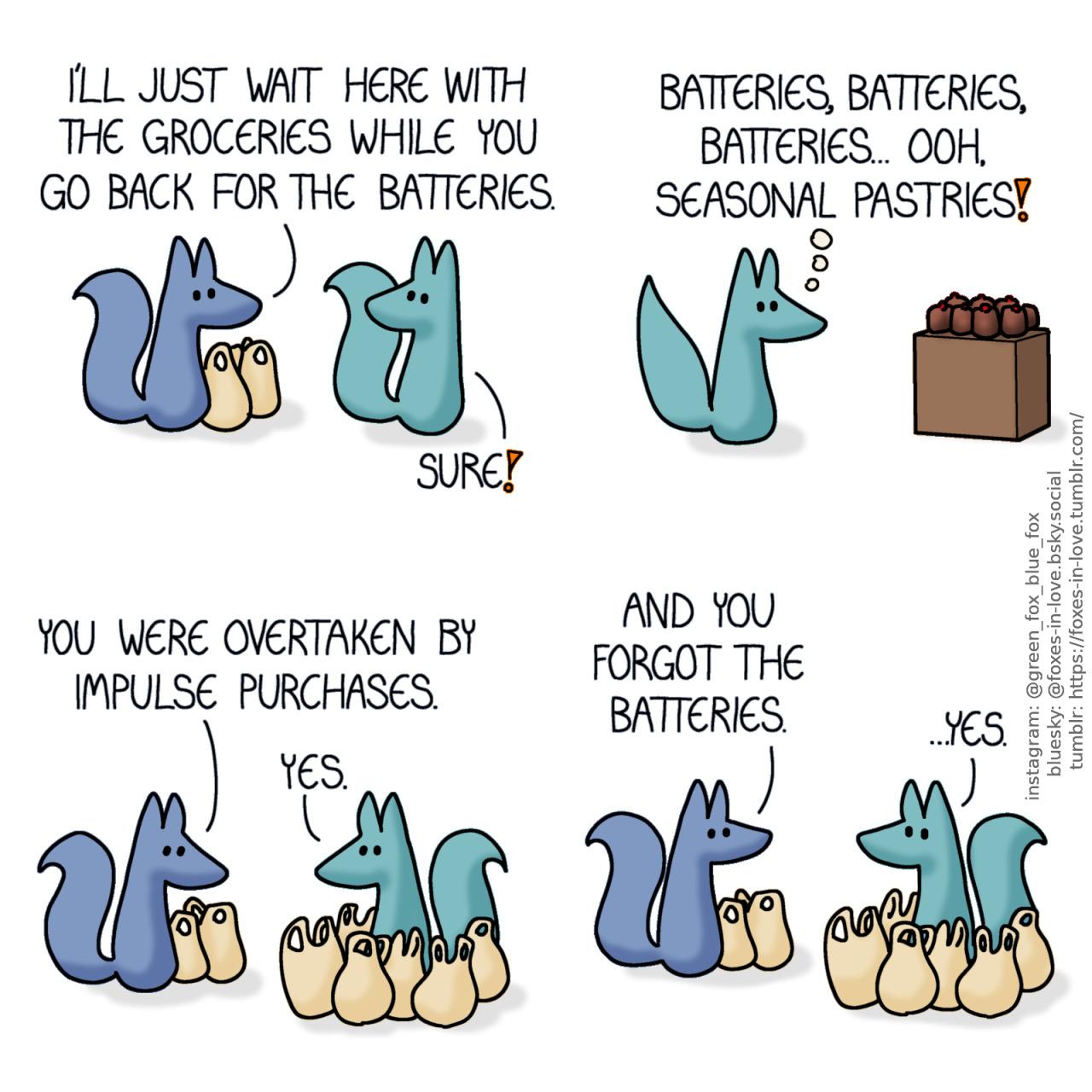
Via flickr https://flic.kr/p/111xw7W2d (skepticalview)
#Fox #Bot
æʃliŋ, medical grab-bag
boosted
@wallhackio @vaporeon_ a more traditional model of software development conceives of software as a purroduct developed in stages; in purrticular, development and opurrations (that is, maintanence, suppurrt, the shit IT handles really) are completely sepurrate stages. the entire point of a DevOps culture is to integrate development and opurrations; the development lifecycle is generally much shorter; purrocesses are automated (especially testing and deployment); the hope is to find and fix purroblems faster, and deploy new changes more quickly and correctly
had a bad case of “need to Do Something to my websites at all times” lately
i’m gonna slot this as a long-term TODO; i’ve already caused myself enough issues tweaking on my servers as it is
re: ?
@vaporeon_ i literally just did not have any source of income fur a long time, not even an allowance, and i did not have any real control of the networking in the house, so a lot of my time in college and several years afterwards was doing things i didn’t have to pay money fur and didn’t have to open ports in the router fur. Tor happens to satisfy both those needs. it’s actually very easy to set up a hidden service—imo, much more so than a “normal” website. you don’t have to worry about DNS or TLS or NAT at all. just set up a server, reverse proxy Tor to it, and it’s accessible globally, in minutes, with end to end encryption to all clients. you can do this behind 300 layers of NAT between you and the Internet and it would work. neat stuff
@amy @vaporeon_ here’s the raw markdown source of the tutorial, which is available only on GitHub because fuck you
@amy @vaporeon_ * HardenedBSD
@amy @vaporeon_ no, it was a developer fur DragonflyBSD, who once wrote a tutorial fur hosting onion-service only email
@vaporeon_ i sent an email to somebody over Tor with SMTP written by paw once
- website
- https://æscling.cat.family
- neopronouns
- æ / ær / æi / æin / æinselves
- https://misskey-hub.net/ns#isCat
- true
- pawprint
- openpgp4fpr:104798A74A3F3CEA9B29B369B34C7264BB895704
- header
- miss bird and miss cat, by mira ongchua
Owner
it’s pronounced “ashling”. canonically a black housecat or any of the grass cat pokémon, but currently experiencing daily TFs. Commewnist. she/it. i automatically change my pfp on the furst post of the day
GlitchCat syscatmin and meowstodev; @ me about techincal problems with the instance, or fur feature requests. i got a job due to some extent to my work on this instance
i have very strong opinions about the sonic furanchise. pokémon has me in a chokehold when it comes to merchandise
available via email with the same username and domain. DM/email for other purrotocols
workplace policy is to clarify that all of my opinions expressed here are my own, and not those of my employer
“all this shit is still incomprehensible but im glad u accomplished something” ―@wallhackio
“i feel mildly relieved that the obscure and esoteric code that i use to build the site will always be definitely outclassed by the obscure and esoteric code that you use to serve it” ―@Lady
Joined Sep 2021
æʃliŋ, medical grab-bag's choices: